
Blog, part 1
Happy New Year! A little reflection...

Another year is over. Only hours remain of 2025 and we are sitting and reflecting on how the year has been. Right now we feel quite depressed and down but we are fighting on. Yesterday we sat and thought about whether Life as Plural makes any difference... Whether it helps anyone or not, because that is what we want, that LsP can actually help someone on the way. Of course, that is not the only reason to run our social media, it also helps us to be able to put words to and document things in our lives. So what has happened in our lives during 2025? We will try to look back using our calendar, photos on our phone and our social media. My spontaneous feeling of the year is = Chaos and depressions...
January:
I think we spent New Year's at home at the accommodation. It was snowing and we weren't feeling too well then either. We bought a DJI selfie stick, it was fun to tinker with. Gave us some energy to make videos for Life as Plural. Went to the Gothenburg Opera with the kids, sister and brother. We saw Charlie and the Chocolate Factory.
February:
Painted a picture and had the first outdoor coffee of the year. Greeted grandma and the weather was fantastic. Had extensive surgery (removed four hemorrhoids). Which triggered our PTSD somewhat terribly. Painted another picture. My mental state got worse and worse. My son decided he didn't want to see me at all for a while.
March:
Was on Sveriges Radio P4 Väst and talked about Dissociative Identity Disorder on DID awareness day. It was fun and the host asked very good questions. Was admitted to the terminal psychiatric ward for a couple of weeks. Decided that our book; She Falls Heavy, should be published as an audiobook. Did a lot of puzzles. Was at the 1st birthday party for my best friend's youngest son. My son was moved to a HVB home.
April:
Started building my grow boxes. My uncle died. Went for long walks and had my best friend visit. Suddenly it was summer. Did a lot of sewing, made some clothes for my best friend's daughter. Went to grandma's. We were interviewed by Göteborgs Posten.
May:
The cold snap killed almost all my vegetables that I naively planted out in the April heat. Going to grandma's place to celebrate her 40th birthday. Throwing a party for my brother's oldest. Saying hello to my sister. Having my best friend visit and discovering moisture in my house... Doing some fishing and counting down to the audiobook release.
June:
Visiting my best friend and going to my other best friend's daughter's student. At grandma's for midsummer. Not feeling as well as we want to pretend to be. We were in Verkligheten in P3.
July:
Feeling worse and worse and a hospital circus begins. Almost lost my life... The police filed a police report for gross misconduct against the doctor who was taking care of us at the time. We have reported to the IVO... Been in and out of hospital for almost the entire month. Sees my son for the first time since February. Does a lot of puzzles. Goes to a party for my niece. Picks blackberries.
August:
Working out at the gym and practicing braiding my hair. Recording a podcast episode. Braiding my hair with pink extensions. Finding out that the person who was supposed to read the book dropped out. We decide to do it ourselves, as it would have taken another 8 months otherwise. The son is moving to a new family home. We were on the podcast; All We Are.
September:
Going up to Stockholm to read our book. Luckily we had our cousin as support. It was intense but fun to record the book. Painting a picture for my best friend's birthday. Going to my friend's art exhibition and celebrating my son's 15th birthday and my sister's daughter's 12th birthday at her grandmother's. Trying to pick mushrooms but only finding poisonous and inedible ones... Feeling a bit hyper, like we have to keep going so we don't crash again.
October:
She falls heavily, released as an audiobook. Report the company that built the house to ARN because they are not answering me. Feeling worse and worse again.
November:
Knitting a sweater and being admitted to the psychiatric ward again. Picking mushrooms and this time we find a couple of kilos. Noticing that the facade of my house has started to crack.
December:
Preparing the last things for Christmas but have zero Christmas spirit. Going to visit my bestie and celebrating her son's 6th birthday with a trip to Universeum. Not feeling so good. Doing some more puzzles and going bowling with the family. ARN is putting off the project because the company that built the house went bankrupt, so now we don't know how to fix everything around the house... Celebrating an eventful Christmas at grandma's. The kids had fun, I was stressed out. My son is with me Monday to Thursday. It felt fun! Not feeling so good, destructive thoughts but still survived the year.
We usually set goals for the year every year. We usually never make promises that are impossible to achieve, but we set goals under headings. So how has it been this year?...
Health and fitness:
We planned to do yoga four times a week, walk every day, and exercise regularly. It has gone well in periods when we have felt okay and less well when we have felt bad. But we have strived for the goals at least.
Economy:
Here, among other things, I would stick to the budget and not buy unnecessary things that I really can't afford... It went well in the first half of the year but crashed during the summer. We have given up on saving completely, especially since the government increased the high-cost coverage for medications. The entire first half of the year is spent paying for the medications and healthcare fees (because my high-cost coverage there also expires then). Then there are lots of birthdays and Christmas, which tend to be quite expensive because there are many nieces and nephews and not to forget my own son.
Family and friends:
Meet family or friends at least once a month. We've probably managed to do that most months, either someone has come here or we've gone away. Talk or text with our son every week. We've failed miserably here, unfortunately, because our son didn't want this. Towards the end of the year, our son has started to make more contact again. Talk to grandma every day. We've talked to grandma almost every day.
Interests and leisure:
Go to the stables on Tuesdays and do water aerobics one day a week. The stables have been going pretty well except when we were hospitalized. The water aerobics has been more sporadic but I've still tried to stick with it.
Life as Plural:
Here we wanted to develop Life as a Plural at a leisurely pace but without stressing and only posting when it feels meaningful. We also thought that we would write regularly on the blog. I think we have succeeded quite a bit. Maybe not with that thing about not stressing about posting, but we have worked more on taking it easy in 2025 than we did in 2024. We also wanted to continue that thing about lecturing but unfortunately haven't had the energy to pursue it.
Therapy/Personal development:
Using Daylio every day. We have succeeded well here, we have logged at least once a day all year. We wanted to continue learning about Dissociative Identity Disorder and other psychiatric issues. We have read some new books and have become familiar with the subject, but we have not been able to do much more. We wanted to continue working on our inner communication. Together with our friend who also has DID, we have been working inwardly and things are slowly progressing. However, we would have liked to be able to talk to our counselor about this, but it has not gone so well. We thought that we would talk and communicate more with the staff and counselor about our feelings. It has gone so-so, but we are working on it. Some people are easier to talk to than others... Then we wanted to work on acceptance and that all parts should be allowed to exist. This has gone reasonably well for some parts at least. It is difficult to accept certain destructive parts.
That was a little summary of the year. How much of this do I remember? To be honest, I don't remember the spring at all, otherwise it's a bit hollow how it was. I can see what we did but I can't imagine the feelings we had. Right now we're not feeling very well and that means we're shutting down a lot when it comes to emotions. Right now we're fighting not to seek psychiatric help... After the events of the summer, we've had permanent headaches and brain fatigue, so we've managed to fight through the autumn, which is pretty good work anyway. Luckily, the headaches haven't been sharp all the time but dull, so we've mostly taken headache pills when the headaches have increased. We've plucked up the courage and reported the summer's events to LÖF.
This year's New Year is celebrated alone, at home in our psychiatric facility and it actually feels quite ok. We actually don't feel like celebrating, especially not when we feel like this. We stuck together at Christmas, doing the same on New Year's doesn't feel doable either. So now we have to get a grip on ourselves and finish My goals for 2026.
Hope you have a fantastic 2026!!
Warm regards Joy
Here we go again...
I am so incredibly tired of the debate about "repressed memories". Now in connection with all the fuss about Lundell and the SVT documentary Hatet, all the self-proclaimed experts are starting to get into the act online... It's like two camps and both claim that they are right and that the research supports them. I am so tired of constantly being invalidated and basically told that I cannot or should not exist. Because that is what all these experts convey, that I cannot exist because "research" says that you cannot repress memories. But this is not true, over the last century hundreds of scientific articles have been published that explain how and why the brain dissociates difficult traumatic memories. The memory is not gone and disappeared, it is simply the brain that has dissociated itself around the memory in order to be able to function in everyday life.
In DSM-III (1980), the existence of memory loss following traumatic events was recognized. The diagnosis is called Dissociative Amnesia. The criteria for Dissociative Amnesia include; "... an inability to recall important personal information, usually of a traumatic and stress-related nature, that is far too extensive to be explained by normal forgetfulness." Memory loss has been a criterion in the diagnosis of PTSD ever since the diagnosis was introduced.
In Bessel van der Kolk's book, The Body Keeps Counting, we get a comprehensive picture of the phenomenon of amnesia. A sociologist and criminologist named Linda Meyer Williams conducted a study that began in the early 1970s. She interviewed 206 girls aged ten to two who had come to the hospital after being sexually abused. The consequences of the abuse were documented in the hospital records and in Linda Meyer Williams's documents from the interviews. Seventeen years later, Williams managed to track down 136 of these children, who were then adult women, and she conducted follow-up interviews. Just over a third of the women (38%) did not remember the abuse documented in their records, while fifteen women (12%) said they had never been abused as children. Over two-thirds (68%) stated that they had been exposed to other sexual abuse in childhood (in addition to those documented in their records). The study showed that the likelihood of developing amnesia about sexual abuse was greater the younger the child was at the time of the abuse. The study also examined the reliability of rediscovered memories. One in ten women in the follow-up (16%) said they had forgotten the abuse at some point in the past, but later remembered what had happened. Compared to the women who had remembered the abuse, those who did not remember were younger when the abuse occurred and had received less help and support from their mothers. Williams also determined that the rediscovered memories were about as accurate as those who had never been lost. All of the women's memories were accurate regarding the central facts of the event, but none of their stories matched all the details in their journals.
Williams's findings are supported by recent neuroscientific research that shows that repressed memories tend to return to the memory bank somewhat modified. As long as a memory is inaccessible, it is impossible for the mind to change it. But as soon as a story begins to be told, especially if it is told repeatedly, it changes. The act of telling itself changes the story. Consciousness cannot be prevented from creating meaning from what it knows, and the meaning we create in our lives changes how and what we remember. The existing evidence that traumatic events can be forgotten and then resurface years later is extensive.
Bessel van der Kolk writes that nevertheless, nearly a hundred reputable memory researchers from several countries risked their reputations when they came out and said that research on memory and repressed memories was junk science because the studies could not be carried out in a laboratory. Another tradition in memory research is to say that eyewitness testimony is not reliable. It is important to see this aspect as well because it calls into question the interrogation technique that police and courts often use. The thing is that there is a big difference between ordinary memory and trauma memory. The fundamental problem is that experiments in a laboratory cannot be considered equivalent to the conditions under which traumatic memories have been created. The fear and helplessness that develop PTSD cannot be recreated in a laboratory. What der Kolk means by that is that if you want to study a traumatic memory, you have to study the memories of people who have been traumatized in reality.
van der Kolk et al. found two main differences between how people talked about positive memories and traumatic experiences. These were; How the memories are organized and The person's physical reaction to the memories. A normal memory was usually coherent with a beginning, middle and end, without periods of amnesia. Traumatic memories, on the other hand, are often fragmented and messy with some details clear, such as what it smelled like or what the curtain looked like, but they could not reproduce the timeline of the event and other important details. The memories of the traumatized came more as images, physical sensations and intense emotions. van der Kolk believes that his study and the studies that Janet did a hundred years earlier prove that traumatic memories differ in a crucial way from ordinary memories and stories from the past. They are dissociated: the different bodily sensations that surged into the brain when the traumatic event occurred are not properly joined into a story, a piece of an autobiography. van der Kolk also shows that recalling memories of traumatic events with all its associated affects does not necessarily dissolve the traumatization. His research does not support the idea that language can be a substitute for action and that exposure therapies such as CBT do not produce results in severely traumatized people with PTSD. The majority of patients treated with such methods continue to have severe PTSD symptoms three months after treatment has ended. Here I also feel that it is extremely important that trauma research is spread. We have had DBT (similar to CBT) which did not give us a single bit of help. After this did not give the results that the healthcare system wanted to see, they said we were treatment-resistant... instead of trying to find what actually works for us and other severely traumatized people.
What do I mean by this? Well, it's complicated, but to claim that memories cannot be dissociated and then resurface many years later is pure and simple falsehood. Lots of research points to this. So now we've had to assert ourselves a bit... as I said, I'm tired of being gaslighted that my memories and experiences are wrong. But it's important that people around the traumatized person don't put words in their mouth. Police and children's homes and courts really need to review how they interview victims and witnesses. But that's a whole other discussion...
All the best to you!
// Freya
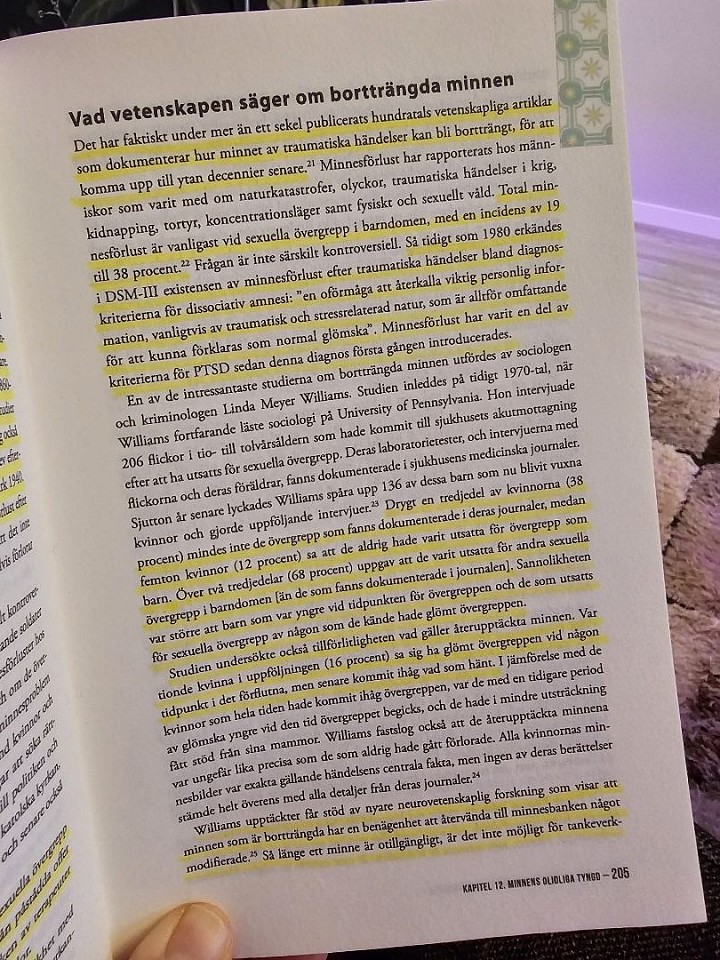
Image on page 205 from The Body Keeps Counting by Bessel van der Kolk
A little chatter from us...

Yesterday we baked saffron donuts with white chocolate filling. They were delicious, we're going to have the rest for Christmas at grandma's. I took the usual saffron bun recipe from Ica and mixed chopped white chocolate with vanilla powder, a little icing sugar and melted butter.
We have finally been told that we will get a transport service in the new municipality, but it turned out to be 10 times more expensive than we thought. Absolutely crazy! It feels crappy and limiting because we will not be able to visit family and friends like before. Now it sounds like we have traveled a lot, which is not true, we have traveled on average maybe 1-2 times a month, some months not at all. Now we cannot travel at all in some months, such as when the high-cost protection for medicine and healthcare expires, which they will do in the spring. Then we will have medical expenses on a multi-fold basis plus healthcare costs when we go to the hospital, counselor or doctor. We posted a video about this with a transport service and got mostly good feedback, so that was good. We have applied for additional cost compensation and hope to get it, then the financial pressure will ease and we can visit people. Imagine how isolated we will be otherwise...
Otherwise, we are quite low and stressed before Christmas. It will be cozy and fun, but at the same time, there will be a lot of us at Grandma's and then it can be difficult to get away if you need to be alone. It feels uneasy with dissociations and changes... but I'm sure it will be fine.
We had a doctor's appointment with our regular psychiatrist (since 2015) and it went well. She's great and that's nice. I just hope she's around for many more years... she's getting older so I'm a little worried she won't retire soon...
God I'm whining today. Trying to stay positive about most things but sometimes it's hard. Today I talked to Grandma and my one best friend J. It's always nice to talk to them. We call Grandma every day (almost anyway) and check on her well. It's kind of cool that she turns 95 in February. Grandma means everything to us.
Don't forget that you are important! Even if it doesn't always feel like it right now, you are. And, it gets better. Life goes up and down but it gets better. (We're bad at remembering this ourselves...)
// Freya
Different forms of dissociation.
What is dissociation?
Dissociation means; To disconnect from one's thoughts, feelings, memories or sense of identity. Dissociation most often occurs as a survival mechanism in the face of severe stress or trauma. Reality feels unreal and distant. Dissociation is a mental process that involves separating experiences from consciousness.
Why does dissociation occur? It is a protection for the brain against overwhelming emotions, especially in the case of severe trauma. The brain disconnects the unpleasant in order to be able to deal with the traumatic situation.
Dissociation is not the same as psychosis (psychosis can occur when living with a diagnosis of schizophrenia, among other things). Dissociation is a normal human reaction when experiencing strong stress or trauma, but it becomes a problem when the dissociation becomes pathological, i.e. unhealthy, and you dissociate so often and a lot that it becomes a problem in everyday life.
Mild dissociation
You could say that dissociation exists on a spectrum. Not all dissociation is due to trauma. Mild dissociation is completely normal and is often called daydreaming. You get caught up in your thoughts and may, for example, miss parts of a conversation. This happens to everyone sometimes, but for someone who is traumatized, zoning out can be more intense and happen more often and become a problem.
For example, you may experience dissociation when traveling a road you often take. You are driving and suddenly realize that you don't know how you got from point A to point B. You have been driving on autopilot and don't remember parts of the trip. You can do chores, such as cleaning, but not remember the details of when you cleaned. Your body is functioning but your consciousness is not fully involved. This often happens when you are under severe stress, overwhelmed by emotions, or tiredness.
In addition to mild dissociation and going on autopilot, there are several other types of dissociation.
Depersonalization
Depersonalization is when you feel disconnected from yourself. You may feel like you are seeing yourself as if you are outside your body. You may feel like a robot, unreal, or like you are not doing anything. Your body feels numb or distant. It is a frightening experience but is a response to severe stress and feeling overwhelmed. You are not crazy, but you often feel that way.
Derealization
Derealization is when the world feels disconnected. You may feel that your surroundings are unrealistic, dreamlike, foggy, or distant. Sounds may feel muffled or too sharp. Your vision may become distorted, as if you are looking into the distance or through a tunnel. It is the body's defense.
Emotionally numb
When you feel emotionally numb, it is more difficult or impossible to feel your feelings. You may feel emotionally empty and it may be harder to feel connected to others. This often happens after a trauma or when the entire system is overwhelmed.
Dissociative fugue
This means that you can lose who you are and where you are going, which means you can wander or travel without a destination and without carrying important things such as keys, wallet or even shoes and jacket.
Dissociative stupor/Freezing reaction
You feel frozen (not cold but stiff) in your own body. You cannot speak or move properly. The brain may feel empty and sluggish. In stupors, you often stop responding to stimuli such as sound, light and touch. It often happens that we do not respond to pain stimulation. This happens when emotions are overwhelming, the body goes into protective mode. This happens to many survivors of complex trauma.
Identity confusion
This happens to people living with Dissociative Identity Disorder (DID) and Dissociative Disorder Unspecified (DSD). You may feel a shift in your level of consciousness or sense of self. You live with different sub-personalities that may have different ages, memories, emotions and roles. You lose track of time or feel co-conscious. This is also called structural dissociation and is not the same as dissociating and "just" zoning out. Structural dissociation is at the far right of the dissociative scale (if you count mild dissociation as at the far left.
As someone who lives with Dissociative Identity Disorder, I often experience dissociation of various kinds, usually on a daily basis. Dissociating is incredibly uncomfortable and often comes at a very inconvenient time. We can shut down and dissociate in some way or switch personalities at basically any time. It is not something we can control or choose. It is a trauma response.
// Jonas

Loss of Control and Acceptance!

When you live with dissociative identity disorder, you have to constantly try to accept the situation you are in. You are completely powerless in the meantime and can do nothing but go along with it. We cannot prevent a change or choose who is on the front. With this often comes anxiety and worry because you can powerlessly watch when some other part does something that you do not want us to do at all.
What many people don't understand is that switching is not a choice. Sometimes it is trauma-driven, meaning that you switch because something triggers a traumatic memory/flashback. Sometimes a switch is automatic and sometimes you switch so quickly that you don't have time to react. A switch can also take a long time, which can leave you feeling confused and foggy.
I often get stressed and anxious when I feel someone else approaching the front, largely due to the powerlessness and loss of control. I get anxious, my thoughts get mixed with someone else's and my body feels distant. All I can do when I feel a shift coming is hope that the other one doesn't worsen the situation we're in or that we end up in a dangerous situation. Some parts stress me out more than others. Some parts are safe and logical while others are chaotic and panicky. Some parts can be downright dangerous as they can harm us in different ways.
Sometimes parts do things that I absolutely do not want. Some eat worse; have eating disorders, some can, as mentioned, self-harm or even be suicidal, some parts can decide things that the rest of us are not at all in on and some can say and do things that, for example, I would never do. Afterwards, some other part (for example me) has to clean up after the person who caused it. Then we get into the topic of responsibility and, above all, that the entire system takes responsibility for what we do. Parts can, of course, but should not blame each other. It is everyone's responsibility for what we do and cause. This is a problem because I often do not remember what happened when another part was present, to the extent that I was not co-conscious, that is, observed the one who is leading in the HUB.
What we can do to reduce the problems is to try to communicate with each other. For example, to try to deliberate together instead of making a quick decision on your own. That those who can and know explain why it is dangerous or not good, for those who do not have that competence. Parts do not do things differently to fight, they do not try to ignore all the other parts. They simply do not have access to the same tools as other parts. They may not know about other parts or that they are still living in trauma and are stuck in survival or that they have not had therapy because they have never faced up when we have therapy.
Those of you who have read the blog know that we are often told that we should only "bring out the real Joy" or that you only want to talk to a certain part and other parts are not allowed to front... This is incredibly invalidating. If we could have chosen who fronts or when we switch, we would have done this, but that is not how Dissociative Identity Disorder works. Especially not when it is small parts that front or parts that are stuck in trauma. When a sad, depressed or suicidal part fronts, they do not need to hear that they are not welcome, they need to be met with compassion and patience.
Switching and fronting after another party has fronted and made it happen is shameful and confusing. You don't remember conversations you had or decisions you made or behaviors you didn't want to have. You are caught off guard and feel guilty, you have to put together a puzzle to understand and you have to take responsibility even if you didn't front at the time.
Why is this happening?! It's not about being out of control. It's about a brain that is built in defense with parts that have different levels of consciousness and that the trauma responses are stronger than logic. The dissociative system does exactly what it's supposed to, it's just that in the present, the trauma responses are no longer necessary but relearning is difficult and takes time.
For us, it is most difficult when a dysfunctional part fronts up. Even though we try to explain internally why something is not a good idea or try to reassure the part that there is no danger, the fronting part does not listen. For me, this is frightening and I feel a loss of control, which makes me and several other parts stressed, worried and anxious. Healing is not about perfection and control, but about building communication between parts and in this way being able to build trust and security. Even between parts that have not been in therapy.
I or we are trying to build communication but it is so incredibly difficult. Right now life feels chaotic and I hate the feeling of losing control but it is just trying to accept the situation.
This weekend we went to visit our best friend. We went to Universeum. Thursday afternoon was an excellent choice, there weren't many people so we could just take it easy and enjoy. We gave our best friend's son an annual pass there as a 6th birthday present. It was three hectic but fun days, we felt dissociative a lot but it still went well. Our best friend knows about our diagnosis and is very supportive, so with her we always feel welcome and accepted as whole.
Christmas is fast approaching, there will be a lot of us at Grandma's. It will be fun but we are also bracing ourselves. We get tired and dissociative easily but as long as we can get away for a while and rest, it usually works.
Hope everything is well with you!
// Freya
Is this reasonable??!
Today we spoke to the transport service manager again and had our fears confirmed. Here, the various municipalities have joined forces and expanded the transport service area with the result that trips will be more expensive. Going to grandma's will cost 1000 SEK round trip, visiting bestie 700 SEK round trip and going to dad 700 SEK round trip... Is this reasonable?? For us it's madness. We will be completely isolated because we won't be able to pay these costs. So right now we don't know what to do... I'm very sad, anxious and angry. Talk about kicking those who are already down! Previously, with the national transport service, we paid 130 SEK one way to grandma's...
What's the point of life when you can't live a life anyway... That everything should be about turning the tables or not being able to do things at all...

What we wish therapists understood...
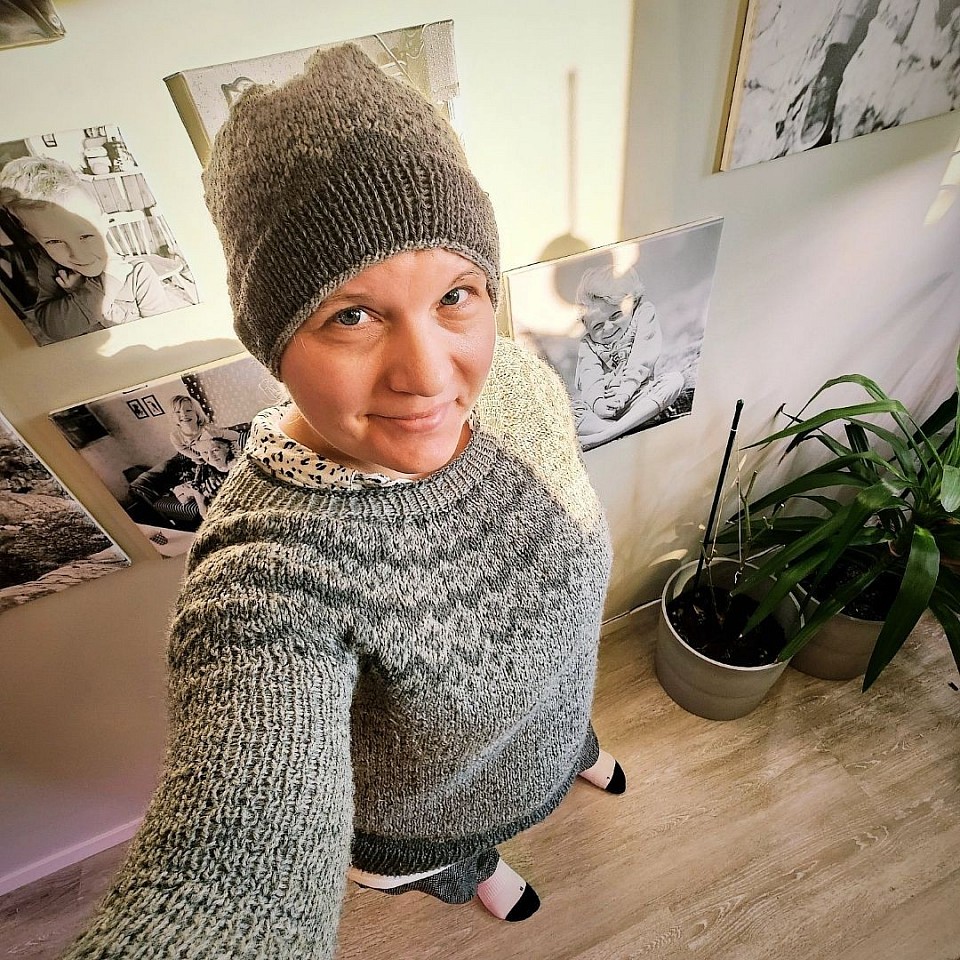
We wish therapists could understand that you can't just treat the part that they consider to be the genuine or basic part. For us right now, it doesn't feel like we have a basic part (but this is very individual. Some feel that they have a basis). Who fronts the most varies with how they are feeling and the situation. You can't get better by only listening to one part. The one who fronts the most is not necessarily the one who is feeling the worst or has traumatic memories and it is primarily the traumatized parts that need therapy... but also the other parts to create cooperation in the system.
You can't put the burden of taking care of and fixing all the other parts on one or two parts. No part should have to feel that pressure. It doesn't help but backfire. If one or two parts are given too much responsibility, it will only result in the whole system going into a rut and, above all, that that part(s) can't handle it. That part(s) also has feelings and struggling energy. All parts need support and therapy, not having responsibility thrown at them. DID is not about controlling and repressing parts. It's about getting cooperation in the system.
Many parts (most in our system anyway) are EP parts. This means that most of them cannot front themselves and if one of them happens to do so, we will not function at all at that time. They can affect inside in different ways, so when we say that we have 20+ parts, only a few actually function in everyday life. But just because it is an ANP part, it does not mean that that part/those parts should take all the responsibility for the entire system.
This is a bit like the same thing we talked about in our last post. All the parts must be present, even the dysfunctional ones. In our case, most of the parts get worse if they are suppressed and ignored. It creates discord inside. No one wants to feel ignored and invisible. Maybe we should write a letter to our therapist and the staff at the facility about this...
This weekend we had a rough time, we dissociated a lot and one of our child parts fronted with a teenage part as the co-conscious. The staff here is fantastic but just because "Joy" didn't front they said for example that they wanted Joy to come forward. We can't decide who comes forward and Ella felt overlooked and unwanted, which is not good at all. It's like some people have got the idea that some of us are not allowed to front or exist. The staff would just like to know how often "Joy" doesn't front or is in the HUB at all. Most of the time everyone masks who is fronting but some parts have a hard time with this, especially the youngest parts. Jonas (teenager) is fronting a lot right now but it's rarely noticeable because he makes an effort to do all those adult things.
All the best to you!
// Freya
Everyone must be allowed to exist!
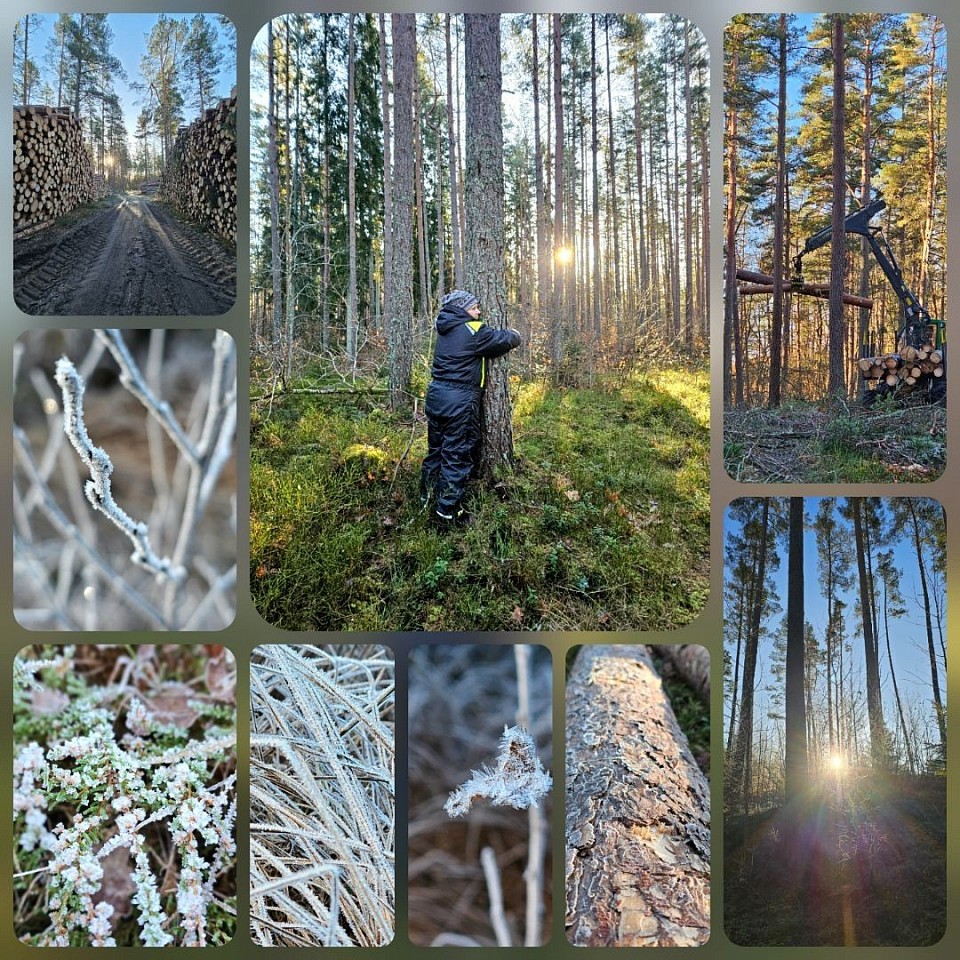
Today it is beautifully wintry outside. We took a long walk in the forest and I am glad we chose the overalls. We were discharged on Friday, it has gone well but we are still not feeling so well. Besties with their two youngest children were here yesterday (Sunday), it was a good distraction.
One thing we often encounter is that parts of us are ignored, as if they don't exist. Many times we get the comment; But you know the parts aren't real... I don't really know how to react to this attitude, but one thing I do know, that the parts inside are the self and ignoring the parts, pretending they don't exist, doesn't work. DID requires communication, not ignorance and silence. A dissociative system works best when all parts are allowed to be here and are acknowledged, even the angry, scared and misunderstood parts.
Ignored parts do not disappear, instead they often withdraw and lose trust. They easily become more vocal inside or suddenly front. Many of us inside become sad and feel unwanted and wrong. This does not help the part(s) feel better.
A problem that arises in the system is that we try to prevent the "uncomfortable" parts from coming forward because we/I are afraid of what will happen when they come forward. It can be dangerous or embarrassing or very wrong. But ignoring these parts is not the right way to go, on the contrary it often makes it worse. We/I often get really stressed when we feel dissociative or that someone else is about to take over (the times we feel it). I am worried about what others will think and think about how we behave. Often fear of being ridiculed and not taken seriously.
We work a lot on our internal communication, it's really hard, but what we've learned is that ignorance affects the whole system. When we ignore parts, our communication gets worse. The parts that feel unwanted or hated become anxious and bitter. This means that they don't follow what we've agreed on in the system, they become angry, sad, disappointed and ashamed. This results in their psychiatric well-being deteriorating and if someone inside feels bad, this affects the overall psychiatric well-being. We all get worse, depressed and anxious. The whole system sinks...
All the parts are interconnected in different ways, even those that have strong amnesic barriers between them. The suffering of one part affects the whole body, the whole brain, the whole life. Ignoring parts does not make the parts disappear, it only isolates traumatized parts inside the brain without support and help. My point here is not that all the parts should run amok and do whatever they want. The idea is that communication and cooperation should work and that we choose what to do etc. together. That no part just runs over one or all the others.
We often hear that people want to talk to Joy, the "real" Joy. I understand that people say this with good intentions, but no one should get to choose which part is allowed to front and which is not. Many parts become incredibly sad and feel even more wrong. How would you feel if someone told you that they don't want to talk to you? Or that you are wrong... Instead, you can try to get to know all the parts with curiosity and compassion. All the parts are there because they have been needed or are needed now. Most often, a part is triggered in different ways, sometimes you don't know what triggers it, sometimes you just switch. But most often, there is something that triggers it.
Parts that are not safe, for example parts that harm us in various ways, both physically and mentally, are not bad. They are damaged, afraid, angry, confused or have traumatic memories that are not treated and investigated. What these parts need is not to be pushed aside and minimized, they need to be seen and given therapy. Now we have not come that far in all this, but we often encounter distrust and an attitude as if we could choose who fronts and we experience this as extremely unhelpful and invalidating. When parts that are unsafe are present, they need support and in some cases monitoring (in our case, for example by being in the hospital or more frequent supervision by the staff).
So what you can do is accept all of us. Asking us in a system to suppress certain parts is the same as asking us to harm ourselves, but inside.
If you want to help someone with DID, you need to understand, show understanding and interest. A dissociative system heals through validation and being heard. A dissociative system heals by being curious instead of afraid, by communication working and by ALL parts being allowed to have a voice, even if what they say is hard to hear.
All the best to you!
// Freya
Thoughts for the day...
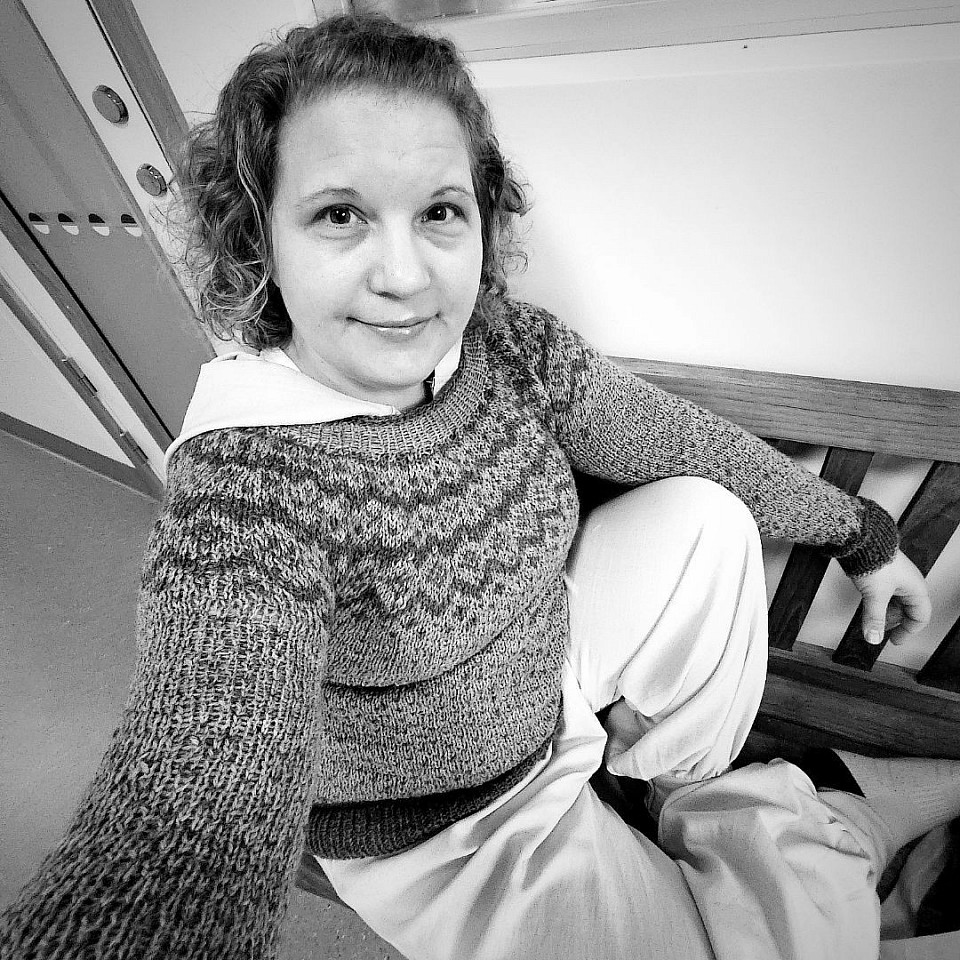
Tomorrow the idea is that we will be discharged... We don't feel ready and still feel really bad. The anxiety is sky high, we dissociate strongly and often and switch hello wildly. I have finished knitting my sweater (see picture) in an attempt to distract ourselves.
However, I have met the ward's fantastic psychologist and we have talked for a while. It felt constructive and rewarding. I told him about our problems and we will see what happens tomorrow. The doctor will probably discharge me regardless, but yes, at least we have tried. It becomes so difficult when the knowledge about my problems is not there and we are not given another chance. It feels like we always have to prove that we are worthy of getting help... That we are not wanted here in the hospital.
Yesterday we were on leave at my best friend's place whose son turned 6. So there was a little cake party and we also had time to play a game. The evening is a big black hole but I guess Ella or Judith have been there as a drawing is painted and there were clothes and blankets on the floor. I hope not too many fellow patients thought I was strange.
Now I'm going to try to deal with our anxiety by knitting a hat that matches the wool sweater. I got some yarn and I think it's fun if they match (however you spell it). I also want to take this opportunity to thank you for all the support you give me both through comments and direct messages. It means a lot!
How are you today?
All the best to you!
// Freya
Closed psychiatric hospital again...
Life rarely goes the way you want it to. We've been a bit down lately, haven't slept well and our heads are in chaos. Yesterday afternoon we were admitted to the inpatient psychiatric unit again. We'll probably be here for a few days but it's better to go in before it gets really bad.
It's so stupid when you live with Dissociative Identity Disorder, life becomes very unpredictable and messy. That's why we are usually so careful with our routines. If it's messy both inside and outside, it becomes super chaotic...
It gets messy because we switch often and many move in and out of the HUB. When we talk about how many parts we have, it sounds like a lot, but the fact is that not all the parts are fully developed or function in everyday life. The vast majority of our parts are fragments and EP parts. EP stands for Emotional part and they usually cannot front. However, they can affect the ANP parts (The "Normal" parts). A myth about DID is that all the parts are very different from each other but it doesn't work that way. At least not in my system. Many parts are similar to each other and most of the ones that are different mask by imitating each other. Most of the parts are fragments and they can have a task or a memory or a feeling etc. A fragment cannot front, I think at least, mine can't. On the other hand, they can strongly influence the part that fronts. I hope I'm not making it too complicated now, because it's incredibly complicated. So it's like fragments and EP parts can take over inside, in the HUB, and then it becomes difficult for the frontman to concentrate and know what his thoughts and feelings are and what is the input of an EP or fragment.
We'll at least try to take care of ourselves and get a chaotic NAV under control now. Hope everything is fine with you!
// Freya
What kinds of flashbacks are there...
The audiobook release started with the meanest comment in the world, but other than that we seem to be getting pretty good reviews. It's just over 4 out of 5 on Storytel. I don't know how it's going in the other places because I only have Storytel. It still feels nervous but we've done our best and can't do more than that.
We have ordered some new psychiatry books. Two of them have arrived; Belted by Maria Ingström and Deep Brain Reorientating by Anna Gerge. It will be interesting to read them. I have started reading Belted and I recognize myself in a lot of it.
Today I thought I would write a little about flashbacks. Flashbacks can look different. You can get flashbacks in the form of:
- Visual flashbacks
Here, for example, a flashback can be played like a movie. You kind of see what's happening. It could be that you see it as if you're experiencing it yourself or as a third person. The visual flashback can also be a hallucination. Above all, we can see figures that resemble our perpetrator, especially at night when we are alternating between waking and sleeping. - Auditory (hearing) flashbacks
Here you can hear sounds you experienced during the traumatic event. It could be someone talking to you or some sound you experienced during the event, for example music. It could be auditory voice and sound hallucinations or you hear a sound that reminds you of the traumatic event and then triggers flashbacks. - Somatic (bodily) flashbacks
For example, in somatic flashbacks, you may feel pain that you felt during the traumatic event. It is common to feel pain and discomfort as if you were where you were at the time. - Olfactory (smell) and Gustatory (taste) flashbacks
Olfactory and Gustatory flashbacks involve the ability to smell and taste things that remind you of the abuse and trauma. You may imagine that you smell something you did then but don't now, or you may actually smell something that reminds you of it and it triggers a flashback. - Emotional flashbacks
Emotional flashbacks are something we often experience. This means that you can have a feeling that can be completely different from how you actually feel at that moment. For example, I can feel happy and calm only to suddenly be attacked by a feeling of fear or sadness.
All kinds of flashbacks are frightening and unpleasant. We have flashbacks on a daily basis, often causing shifts. Most flashbacks are like unwelcome intrusions that always stir things up inside. They cause dissociations and feelings of unreality that are both distressing and difficult to deal with.
The hard part about flashbacks is dealing with them and not getting stuck in them. With a strong flashback, you get stuck in the past, you can lose touch with reality completely. It can be very difficult for someone outside to stop the flashback and almost impossible for the person experiencing it to stop it themselves without help.
The difficult thing is to identify that you are having a flashback, but once you have succeeded in this, it is important to try to ground yourself. You can ground yourself by using your senses. You can use:
- The vision
You can look around and say what you see, or find everything that is green or count the tiles as well. - Feel
You can touch things, textiles or different things. Is it hot or cold, is it smooth or rough... - Hearing
Listen for sounds around you. For example, if you are outside, you can note the hum of the car and the rustling of the trees. It can be difficult to distinguish between auditory hallucinations and reality, so it may be better to ground yourself in another sense. - Smell
Try to smell the scents around you. A good idea might be to choose two scents and compare them, for example, between a perfumed soap and coffee. Describe to yourself how the scents are different and similar. - Taste
It can be good to taste something strong, such as strong mint, Tabasco or lemon, to awaken the senses.
It can be good to focus in the body. It can be very difficult to be in the body when you have experienced certain types of trauma, but it is good to practice so that the knowledge is grounded.
- Move around
If you can move, it's a good idea to start doing this. You can focus on how your feet feel on the ground or how your body moves or what it feels like to balance. - Cold
Using cold, such as an ice pack or ice pack on your wrists or neck, for example. The feeling of cold can help ground you in the present. - The voice
Talk out loud, describe what is around you. If you live with DID, it can be good to talk inwardly and calm the parts that are in affect. - Breathing exercises
Focusing on your breathing and breathing in and out slowly can also help ground and calm you.
It is important to seek help. In the long run, some kind of professional help is often needed and it can also be good to be able to identify your triggers (when they can be identified). It is important to work on having a good lifestyle with regular exercise and good sleep and eating habits. It can also be good to create a crisis box with things that can help you ground yourself in reality.
What can you do as a relative?
Sometimes it can be good for a relative to help ground and distract. As a relative, you can, for example, speak soothingly, explain what year it is and that the person with flashbacks is safe and secure. It is important to ask before touching the person with flashbacks as this can worsen the flashbacks. It is best to make a plan together before the flashbacks. As an instruction; "When I have a flashback, you can touch my arm and hold my hand... I want you to try to guide me with your voice and help me ground myself, by making me reach for things in the room or listen for sounds in the present..." etc.
It is incredibly difficult to just be able to stop a flashback. It requires a lot of work and above all, it can work sometimes and sometimes not. For us, it fluctuates immensely depending on how we feel, the situation and how strong the flashback is.
We know that yellow juice/drink triggers irrational behavior and flashbacks. We are really trying to work on this but it is so hard. Now we can sometimes handle it a little (not running in the other direction) if we know that there will be yellow drink where we are. But if we are "attacked" without warning, we can react very strongly. Phobias and fears do not always have a basis but when they do it becomes harder to get past it because it stirs up so much more than just fear.
What do you usually do when you get flashbacks? (If you do)
All the best to you!
// Freya

I'm so nervous...
I'm so nervous about the audiobook release. What if I don't read well enough, what if the little mistakes just get in the way and people don't have the energy to listen... Well, we'll see it as a good thing to be a little nervous. At least we've done our best and it's the first time we've recorded an audiobook.
Today I feel okay, went for a brisk walk and went to the gym. Haven't exercised in over a week as we were away and then I was both tired and had a bit of a cold. I'm still tired so I'll probably go to bed and rest after I finish writing.
I've had a bit of a busy weekend but today I feel a little better again. Yesterday we did an unprepared podcast episode. Me, Moa and Anna (although Moa's phone went dead so it was just me and Anna) talked about Recovery. It turned out okay but I guess it's okay when we haven't prepared anything. Recovery is incredibly important when you're healthy but becomes even more important if you suffer from mental illness.
We tend to be bad at recovering, we often drive ourselves into a rut and then we crash instead, and that's not so smart... But we try to get better at recovering. Have moments or days when we don't have anything planned or when we do things that give us energy. For us, a walk is usually recovery, there are few things that give more peace and quiet than a nice walk in the forest. Recovery consists of both cooling down and doing things you like (in moderation of course) or meeting someone who gives you energy.
Things we like to do to unwind and recover are:
- Puzzle
- Knitting/ Crochet
- Paint
- Read or listen to an audiobook
- Yoga
- Walk etc.
Anna said something so important, that you should have time without performance. So incredibly important that the cooling down and refueling of energy be without performance, because as soon as we start performing, we stop recovering.
Hope everything is well with you!
// Freya
Lyssnar på din bok nu, du har en väldigt behaglig och tydlig röst. Så det kan du sluta vara nervös över nu 😊
Audiobook release October 22, 2025
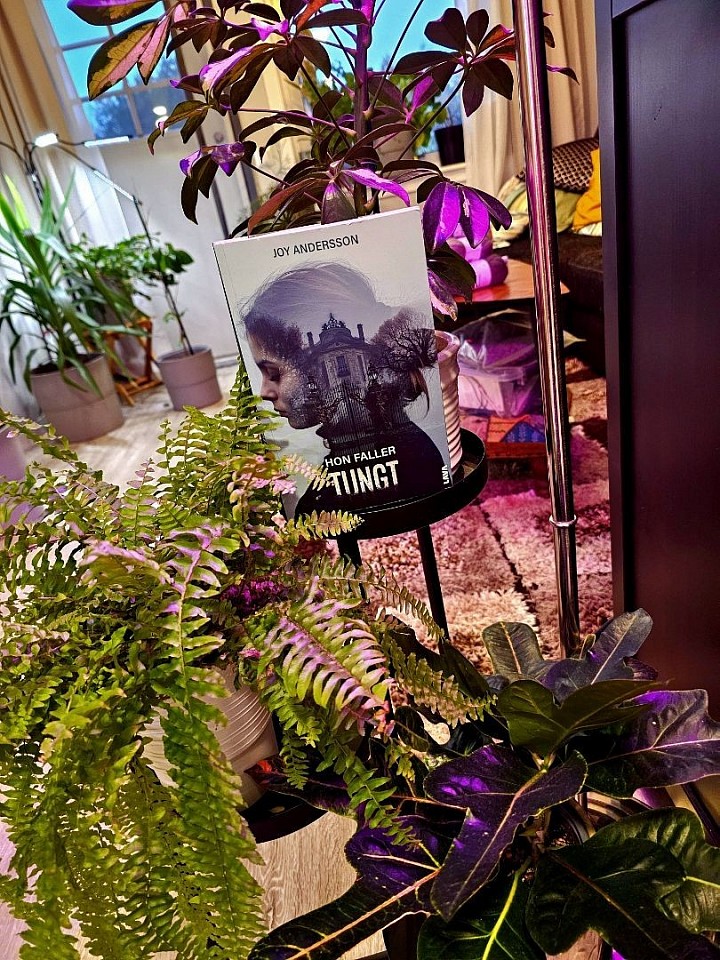
In a week, on October 22nd, "She Falls Heavy" will be released as an audiobook. It feels so incredibly exciting. Finally, the time has come!
To celebrate, we have started a book raffle on our social media. If you want to participate, go to our social media and click on the post from 15/10. (I have pinned the post at the top).
Otherwise, I'm tired, anxious and sad right now. The audiobook feels really exciting and fun, but I feel pissed because I'm so damn tired. Today, we've also had a lot of body pain and feel generally swollen.
The police called earlier. They have reported the doctor who discharged me last summer for malpractice. So great! And we have reported him to the Swedish National Institute for Psychiatry. Hopefully some of this will make psychiatrists think twice.
My kitchen fan has started making noise again and now it's worse than ever. I'm going crazy! I can't bear to listen to this crap... I feel like we've been bad at updating our social media and writing here lately. But I haven't been able to... I've mostly tried to live and feel good...
All the best to you!
// Joy
Here we go again...
Today I saw an article about DID in the Uppsala newspaper (I think it was). Unfortunately, I couldn't read it because it's locked, but of course the ignorance and prejudice are evident in the comments section. We could read about how our experiences are false, that the diagnosis is questioned, and one person compared DID to the Quick scandal. That an extremely unprofessional psychologist (or whatever she was) was both deceived and manipulated Quick was and is a scandal, but it has nothing to do with DID. The fact that DID is questioned is due to ignorance and old myths that have remained since the FMSF (False Memory Syndrome Foundation) was formed and existed. FMSF was founded completely without scientific evidence by some parents in the USA who were accused by their children of having traumatized them, primarily through sexual abuse. (FMSF is no longer around when researchers blew their arguments open and showed that they have no basis in science whatsoever) They wrote "scientific" articles completely without research and science and managed to start the rumor that you can't have amnesia about your traumas. (This is exactly the same thing as Parental Alienation, it is rare for a parent to use this and research indicates that it is not legitimate to use in custody disputes, yet it is spread and used in lawsuits...) There is no such thing as repressed memories, they are not repressed, just hidden by amnesia or saved in a different way in the brain than "normal" memories.
That one cannot have amnesia about trauma is incorrect, we can read in Bessel van der Kolk's scientific publication The Body Keeps Counting about how research has shown that people with severe trauma have amnesia about the event/events either completely or partially. In a study (I don't remember any figures right now and I don't have the book next to me) of people who were admitted to hospital after rape and where injuries and such were documented, a good number of these people remembered that they had been exposed until a few years later. The brain has set up amnesic barriers and has not been able to store the memory in a normal way. Normally, short-term memory is stored in the frontal lobe and at night, during REM sleep, the memories are moved to long-term memory further back (can't remember what the place was called right now). In the case of trauma, this transfer to long-term storage fails and the memory gets stuck. This is what causes PTSD to develop. It's complicated and I can't explain everything here, partly because I can't really right now and partly because I don't understand everything myself. But you probably get a little bit at least and that it's so incredibly complicated.
The study that van der Kolk points to at least showed that a fairly large proportion of the study participants developed amnesia and PTSD. In the case of long-term traumatization, complex PTSD (cPTSD) often develops and in some cases even dissociative syndromes such as OSDD or DID. How can a person who has experienced documented sexual abuse not remember what they have experienced?! Because that is how the brain does it to cope, to be able to continue functioning in everyday life and live a life. A real psychologist neither plants nor encourages finding "repressed" memories, a real psychologist does not put words in the mouths of their patients.
DID is not about having repressed any memories. DID is a trauma diagnosis that, among other things, means that you dissociate a lot and often (dissociating means disconnecting from reality in various ways), you experience that you have multiple personalities and you have amnesia about everyday life, the present, the past and important personal information. On the one hand, you have amnesia about trauma due to cPTSD in combination with amnesia due to different sub-personalities. Many sub-personalities do not communicate with each other and this means that DP1 cannot remember what DP2 has done, etc. Different sub-personalities are like different degrees of consciousness. You can think that you are with your friend, then your friend does something without you, then you cannot remember what your friend has done and they do not tell you.
Prejudices and old myths about DID are so destructive. We exist and our perception of reality and our lives are just as chosen as anyone else's. It is prejudices that prevent those of us who actually live with DID from getting the right help. Unfortunately, prejudices combined with more and more DID by proxy (faking DID) have meant that people do not learn about what it means to have DID. DID is not fun and not crazy and is not about changing commands and changing wigs and clothes. DID is a mostly hidden disorder that causes great suffering for those who actually live with the diagnosis. Constantly being questioned and mistrusted is incredibly tiring and sad.
All the best to you!
// Joy

Lever ensamt men känner mig nästan aldrig ensam.