Blog, part 1
We've had a few good days and tried to enjoy them. Today we went to water aerobics, it's so good for the body when you're in the warm water, you get less pain.
We often have pain in our bodies or we don't feel parts of our bodies at all. Right now we have pain and have sought help at VCT so now we are going to be investigated for Fibromyalgia and possibly hEDS (stands for hypermobility syndrome or edler danlos syndrome or something I think) because I apparently have hypermobile joints... I have sought help before but am only told that it is psychosomatic or that I have to live with it... It feels easier to live with it when you know why you have pain even if there is nothing you can do about it.
// Joy
Time goes by terribly fast...
Yesterday we celebrated my son's 15th birthday. It was a nice party with happy children and satisfied adults and above all a happy and content 15-year-old. I can't believe I became a mother 15 years ago. It's crazy how time flies and I'm so incredibly proud of my son.
At the same time, I get sentimental and sad that I couldn't be the mother I wanted to be. When my son was only 4 years old, I got sick and then it's been chaos for many years. Only now (the last two years) have I caught up a bit. That my son has become the fantastic, nice and empathetic guy he is makes me so proud I could burst.
When I found out I was unplanned pregnant, I wanted to be the best mother I could be, but life doesn't always go the way you plan. I've always done my best, it's just that it's not always enough even though you try. I have a pretty good relationship with my son, the only shame is that you miss out on everyday life. You miss out on little things, like how he wants his sandwich or which friends he hangs out with or what he thinks is the most fun right now.
Being a mother is difficult in normal circumstances, but it becomes a hundred times more difficult when you are also struggling with a difficult psychiatric diagnosis... It becomes such a dilemma.
Hope you have a nice day!
// Joy
DID and sleep problems

Now that we're up in the middle of the night, we might as well take the opportunity to write a little about DID and sleep problems. Sleep problems are also called insomnia and are common when living with Dissociative Identity Disorder. Insomnia affects the entire system in a negative way.
Sleep is extremely important for recovery, it is during sleep that the brain has the opportunity to process memories and emotions as well as recover and stabilize our mood. If you don't get enough sleep, everything becomes heavier and harder to handle.
When you live with Dissociative Identity Disorder, it doesn't just affect one person, it affects the entire system. Sub-personalities become more easily triggered and anxious. Shifts can be harder to keep up with and control, we usually shift more often which becomes difficult to manage. Even co-consciousness can easily feel more chaotic and difficult to manage than usual.
When we end up with insomnia, especially when it lasts for two or more days, everyone in the system is affected. Parts become more anxious, noisier, more difficult to reason with and more sensitive to stress. This makes it harder for us to deal with everyday life and all that it entails. Parts can become noisier and rush forward while others feel pushed aside. We also dissociate more and more strongly than usual when we are tired and sleep deprived.
Dissociations make us feel more disconnected from our bodies. We have a harder time keeping up and remembering things. We either feel too much and have pain in our bodies or we don't feel our bodies at all. Flashbacks and nightmares become more difficult and intense. And our sleep paralysis and hallucinations become worse.
So what can help when you have insomnia? For us, it is difficult to find routines that actually help, but having calming evening routines and working on grounding before going to bed can help. You can have a routine of writing in the evening (or any other time of the day) so that all parts have their say. We often have the Harry Potter books in the evening because we have discovered that this makes us calmer.
Having insomnia is not the same as being tired. Having insomnia affects the whole system and makes you have to struggle more than usual. We always try to work with acceptance when we don't sleep and we try to stay in bed as much as possible. We try to keep going during the day so as not to turn the clock around, but sometimes you need to rest a little or take it easy.
It is important to remember that insomnia is difficult for anyone, regardless of whether the person is living with a mental illness or not. Lack of sleep affects the body, mind and emotions and can make daily life feel overwhelming. This post is written from my perspective as someone living with a mental illness and DID.
Hope everything is well with you!
// Joy
Understanding younger parts
The vast majority of people with Dissociative Identity Disorder have younger parts. Understanding why you have younger parts and accepting that they exist is important.
Younger parts have memories, feelings and experiences from when the trauma happened. They develop to protect the brain and the rest of the system from traumatic memories. A younger part is not an invention or a box, it is a real part of the personality that carries real feelings and needs.
The brain stores trauma differently for children, so these parts remain "frozen" at younger ages. They can see the world from a child's perspective and can therefore think and act as if they are a certain age. Child parts are part of the system's survival strategy and they evolved to bear unmanageable and overwhelming pain when no one else could.
It is important to know that the younger parts deserve the same respect as other parts. They need to be allowed to exist and be themselves. They are not role-played, they are real. Different younger parts can, just like older parts, have different interests, names, what they like & don't like, different ways of speaking and different handwriting. It is super important not to shame a younger part (or any other older part either) when they are themselves, a younger part already lives with a lot of shame and definitely does not need to be ashamed that they exist too.
How should you act when a younger part is present? Talk to them on their level, in a kind way and be patient. Try to keep adult problems away from the younger part unless it is necessary for them to receive the information. Encourage safe games and creativity and be there as a source of security. Depending on which younger part is present, it may be good to keep an eye on them so that they don't come up with something that could go wrong.
I asked if any of the children would like to tell me a little about what they think and have received a few answers. The question I asked was; What is it like to be younger but in a big body and is there anything that you think is important for people to know?
Ella, 6 years old.
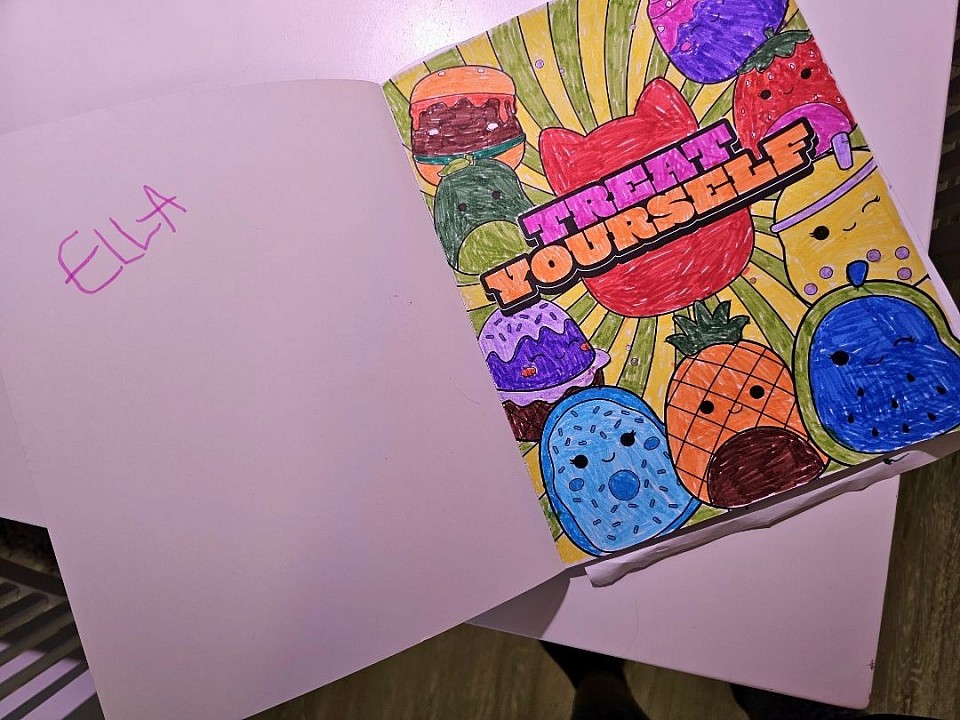
It's weird to be weird because I don't look like I do in the mirror. I get sad because I don't get to be myself all the time. Sometimes I have to pretend to be big and I find that boring and difficult. I love jumping in puddles and painting and playing but I don't get to play that often. I was happy when I got my own coloring book! I want more toys but I haven't got any. I get sad when I feel like I can't be myself and the adults around me get irritated because I'm ahead. I think that's important and hard.
Judith, 10 years old.
I often feel scared and disgusting and like someone is going to hurt me. I don't like being in the big body because I get clumsy because my arms and legs are longer than usual. I think it's fun to sit in the Hub when we're in the stable, I like the horses, they make me feel good. I like Harry Potter and Narnia, they're good books. When I'm not feeling well, I like to paint the bad. I don't like it when adults think I'm annoying or that they roll their eyes and leave me when I get there.
Jonas, 16 years old.
I think it's harder to be in a mother's body than in my own body. I often feel bad and feel like I can't be myself because I have to do a lot of boring adult things. It's really boring! I like playing games, it makes me not feel bad at the moment. It feels like a lot of adults think I'm bad and that makes me sad. I see a lot of black and often don't want to live but I do it anyway, unfortunately. I often feel like I'm not allowed to exist and it's crap.
So it is extremely important that you, who are reading this, think about this when you meet a younger part. If you know that the person in question has Dissociative Identity Disorder, be aware and don't be ashamed that different parts behave differently, it is already difficult enough.
All the best!
// Freya and Jonas
DID and Hallucinations
Did you know that you can have hallucinations when living with complex PTSD and DID?! You can have hallucinations when you have DID, but there is a difference between these hallucinations and psychotic hallucinations (like in schizophrenia).
Hallucinations when you have cPTSD and DID stem from trauma and are caused by dissociation, flashbacks, and extreme stress, not from a break in reality.
There are different types of hallucinations in dissociation and cPTSD.
- Somatic hallucinations
You get a feeling that someone is touching you, that you feel pain in places where you were in pain when the trauma occurred, or that you feel like you are being watched.
This is common if you have experienced physical or sexual violence.
We often experience physical hallucinations such as pain where we have been injured or a feeling that someone is holding us or touching us. - Auditory hallucinations
Hearing sounds, voices and whispers that are often threatening, critical or offensive.
These are often described as inner voices that feel external and stem from trauma and often mimic the perpetrator.
We often have auditory hallucinations in the form of our parts talking to us or commenting and criticizing. Sometimes we even think we hear someone in the room or a little distance away. - Visual hallucinations
You see flashbacks or characters often shadowy and ghostly.
It is common for us to see shadow figures, especially when we can't sleep and the lights are off. This often happens when we haven't slept well for a while or when we dissociate. We have also experienced furniture and objects moving. We also often experience sleep paralysis, which means we can't move but are semi-awake and can, for example, feel that someone is standing in the room. It is incredibly frightening.
So what causes the hallucinations?
- Dissociation
Feeling disconnected from reality and the body. Dissociation often feels dreamlike and unreal.
- Flashbacks
Intense re-experiencing of trauma, often with sensory hallucinations.
- Sleep deprivation
Nightmares and vivid dreams with hallucinations, especially when you are hypersensitive.
- Emotionally overwhelming
The nervous system becomes overstimulated and this can trigger sensory delusions and hallucinations.
It's easy to feel like you're losing yourself, that you're crazy, but these hallucinations are usually rooted in trauma and not psychosis. You usually have the awareness that you know it's not real but you experience it as real, which is the biggest difference between dissociative hallucinations and psychotic hallucinations.
We have quite a lot of problems with hallucinations. It can be stressful and scary depending on why we get it. For example, if we haven't slept properly for a long time and we are half awake, we experience less scary hallucinations such as things moving. During a flashback or dissociation, we can have scary hallucinations such as feeling someone touching us or that we are in pain in places where we were hurt when the abuse took place and that we hear our abuser's voice. We can also see situations playing out like a movie and experience that we are there and then. Often when we get severe hallucinations, we can shut down and dissociate to the point that we can't move or talk.
All the best to you!
// Freya
Recording of She Falls Heavy
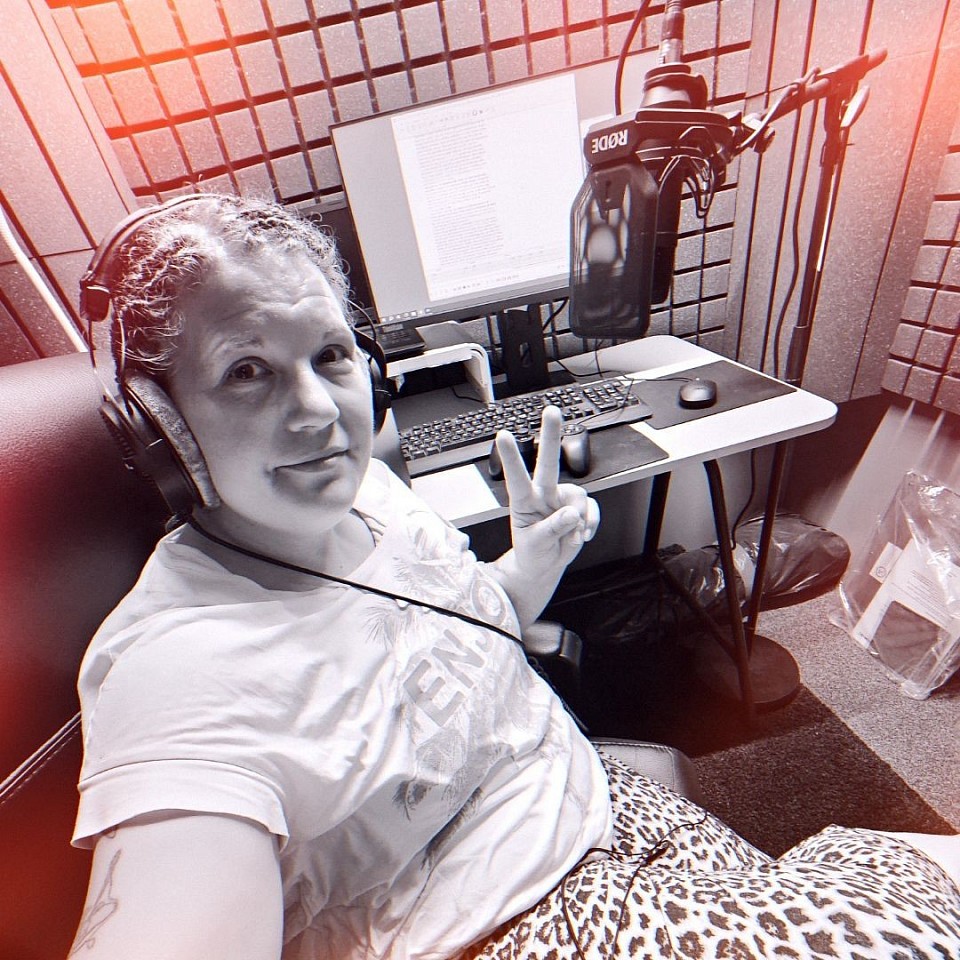
I'm completely exhausted after three days in Stockholm. It was lucky that I got to stay with my cousin. I've now finished reading our book, She Falls Heavy. I was a little worried that we wouldn't have time in three days, but we did just in time. I'm very meticulous and diligent plus I have a very dry mouth (due to the medication), so we kind of read and listened, erased, read and listened, erased, etc. until we were satisfied. Still, we didn't manage to keep the smacking away completely (it smacks when we talk and my mouth is dry) but they said they could possibly get rid of the little bit that is there. Otherwise it felt good, but now we're completely exhausted both mentally and physically with headaches and body aches. We've really pushed ourselves to the max to get this done.
The train journey up and down went great, the train was on time and everything. We travelled in a quiet carriage, which is the same as 1st class except you have to go and get your own coffee. We need as much peace and quiet as possible to cope with the journey as the journey itself makes us stressed and anxious. The less stress the better.
I'm editing a film of the adventure for our YouTube channel.
The audiobook will be released on October 22nd. It's going to be so exciting!
Things I/we experience daily due to DID and PTSD!
Here are some points about experiences we have, often on a daily basis.
- Losing what I'm about to say, often due to rapid changes or someone in my head/HUBT interfering.
- Losing time - Amnesia - Anything from minutes to months. Periods that never come back.
- That I feel insecure in my own life. Like I don't fit in anywhere.
- Constant doubt about my own reality, partly due to my own distrust but also due to the distrust of others.
- Intense traumatic memories, both emotional, visual and physical. Often it feels like they don't belong to me.
- That I/we have different taste preferences, interests, sense of age and gender, etc. These fluctuate throughout the day.
- Changes in handwriting, movement patterns and way of speaking.
- When I look in the mirror but don't recognize myself.
- Not remembering whether I ate or not, slept or not, did everything I was supposed to or not.
- Losing time and entire conversations, who I talked to and what we talked about due to amnesia.
- Finding things at home that I don't remember buying and receiving packages I don't remember ordering.
- Difficulty remembering what to do.
- Feeling unsure of who I am, where I am and what I am doing.
- I have to figure out who is there and do the things that are on the schedule, even if I don't think it's fun.
- Daily fear of loss of control, of not remembering or being able to control what I should or will do.
- Almost constant chaos/ confusion/ HUB, because not everyone thinks the same or agrees.
- Sadness about not remembering things I should remember. Like large parts of my childhood, the birth of my son, and other big events.
- Fear of triggers that can provoke flashbacks of various kinds.
- Worry about ending up in a dissociation where I get stuck and can't move or talk.
- Anxiety/fear that the "wrong" part of our personality will come to the fore. Like a child part when we are out doing something important that requires an adult mind.
- The feeling of constant shame about who we are and what we have been through (even when we don't remember it).
- The fear that a destructive part will front and harm us.
- Worry that the next depressive episode could be our last.
- Pain in the body or not feeling the body at all.
- Dissociations and feelings of unreality of various kinds.
These were some of our daily problems and worries. Next week we are going to Stockholm to read our book; She Falls Heavy. It will be great fun. We will try to film and take photos so we can make a YouTube video about it. However, traveling is a big worry for us. We can't handle the stress and when there are a lot of people. If we are unlucky we shut down and end up in dissociation, or yes we always end up in dissociation and feelings of unreality but I mean a kind of fixed dissociation where we can't move. To reduce stress we have chosen to travel in a quiet carriage, as few impressions as possible is good and when we get to Stockholm our cousin will meet us.
Hope everything is well with you!
// Freya and Jonas (co-conscious)
How do the different parts see themselves?
AI generated images
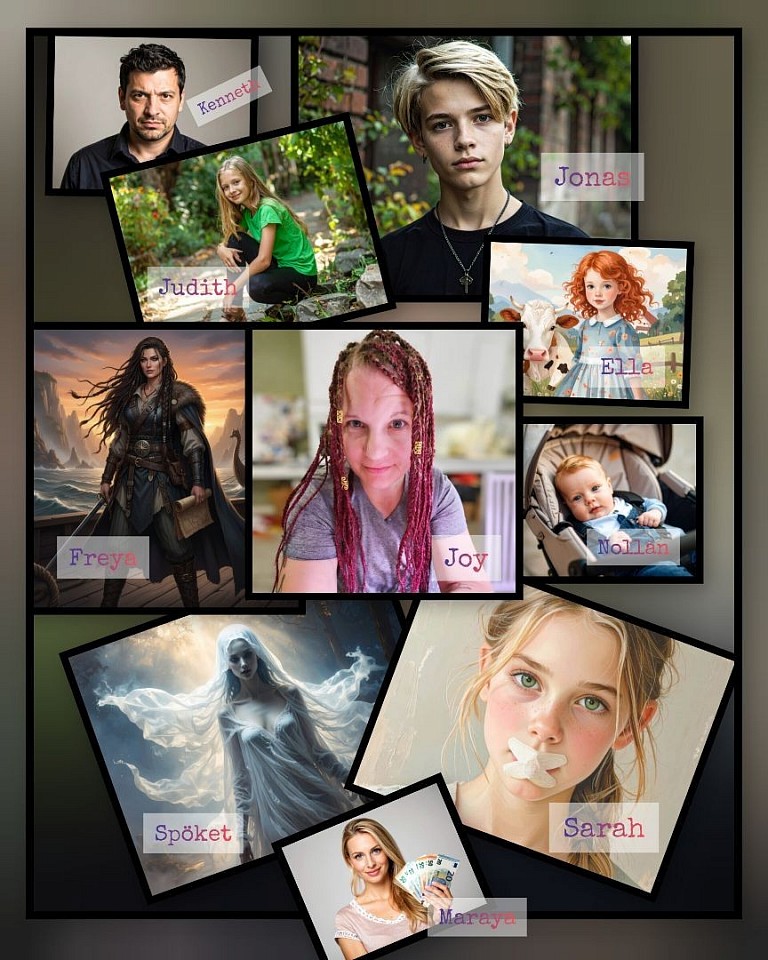
Do all parts look like the body? The simple answer is no. The parts look different in the inner world versus the body's appearance. Some parts have no definite shape while others see themselves clearly.
I let the AI generate images based on how some in the system describe themselves. For example, Maraya and I see ourselves as ageless. Sarah is 11 years old and basically doesn't talk at all, she puts a band-aid over her mouth because she's not allowed to talk. The darkness has no body, it's just a penetrating darkness. Chaos is what she sounds like, chaos. She has no direct form. To me, she's a tornado. Jonas is a teenager and has started to be quite present, he hates doing all the adult things like cleaning, washing dishes and laundry.
I feel different when I'm there. In the inner world I'm of normal height (around 1.70m) and have long dark hair. The body is much shorter than me. I feel almost a bit godlike if you start from the Æsir belief, kind of like Freya there, that's why I call myself Freya.
I heard a girl with DID explain it all so well. I'll try to convey it here. The perception of what we look like is mixed between trauma psychology, neurobiology and our self-perception. Our self-perception is not random either, it is symbolic. The brain mixes memories, emotions and identity. So a part that has certain child memories can perceive itself as a child, a protective part can, for example, be older and ageless and so on. Through brain scans, it has been possible to see that different sub-personalities use different neural pathways in the brain, so when a part fronts, it does not experience itself as the body, this is because the brain takes its information from a different neural pathway than it would have done if the sub-personality had experienced itself as the body. This is also why parts can be experienced differently, have different movement patterns, handwriting and bodily sensations, because the brain generates a different representation of the body. Parts also experience themselves as the role they have in the system.
From a psychoanalytic perspective, the inner experience of a sub-personality is like dream symbols. It is a combination of memories, emotions and unconsciousness, which means that the psyche gives the part an inner mental costume. So it is complicated to explain how it is that different parts look different in the inner world. All parts would probably have answered that question differently. But in answer to the question, one can say that the sub-personalities were never created to be copies of each other, it is more like excesses and developments of the self. We evolved to take care of experiences and feelings that could not be handled by a person and then the brain has given us the opportunity to create symbolism and differences between the parts. So it is short and gone difficult to explain but this is a theory/explanation.
All parts must be present because all parts form the whole, the self. But sometimes it is difficult to accept all parts, some parts do not get along, some parts have a distorted view of how to solve life's problems and some parts are just a bunch of emotions. Some parts are scary to other parts while other parts are protective. For us, we are so much bigger or more inside compared to how many can or are allowed to front.
I hope you have become a little wiser. Don't forget that all systems are different.
All the best!
// Freya
The difference between DID and having parts of one's personality
Sometimes we hear that; Everyone has parts inside, and that is partly true. Everyone has parts of their personality. For example, that you are professional at work, silly with your children and have different friends depending on which friends you hang out with. The difference between DID and normal parts of your personality is that with DID you are not just different sides of your personality you have different states of consciousness. Between the different consciousnesses you usually have amnesia, that is, memory loss. One part cannot remember what the other has done because there are amnesic barriers between the parts, plus it is quite impossible to know what you have done if you have not been conscious.
With a lot of work and curiosity about all the parts, you can completely or partially dismantle the amnesia between certain parts and in this way get a better sense of the whole. Some parts get along while others don't, which of course also causes problems. The antagonists in the system don't get along very well and may not want to share experiences or even can't since all the parts don't know each other. So it's a little more complicated when you live with DID.
Another thing is that everyone dissociates sometimes and that doesn't mean you have DID. First of all, some dissociation is completely normal, the problem is when it becomes pathological but even that doesn't mean you have DID. There are several dissociative syndromes and DID is the most severe form. Normal dissociation is, for example, daydreaming or going through a routine and suddenly being there. Pathological dissociation is, for example, feeling disconnected from reality a lot and often or suddenly being somewhere and not knowing how you got there or where you are.
Hope you have a good day!
// Joy
Some points about Dissociative Identity Disorder that are good to know about
What weather we have today, so lovely. We're taking the opportunity to enjoy it because from tomorrow onwards it will be colder weather and rain. Sad but it needs to rain. We've made a new YouTube video about things that are good to know about Dissociative Identity Disorder. Thought I'd do a little bit here too.
1. DID is a trauma diagnosis, it is not attention seeking and it is not a fad (something that is temporarily popular). Cases of DID have been documented as far back as the late 16th century and are caused by low-level trauma before the age of 9-12, when our personality develops. DID develops for survival, not to manipulate or entertain people and it is certainly not fun or wacky to live with.
2. We don't know exactly how many parts we have and that's okay. Many people with DID don't know how many sub-personalities or fragments they live with.
3. When living with DID, you don't change moods, you change consciousness. Another part, with its own names, ages, gender, interests, etc., takes over the consciousness and body. This often leads to amnesia for other parts/consciousnesses.
4. Amnesia doesn't always mean total blackout. Sometimes it's more like brain fog, loss of time, or seeing yourself as an outsider.
5. We cannot choose who will front (which consciousness will be in front). Most often some part is triggered to front due to external or internal stimuli but not all switching is due to triggers, sometimes you just switch and sometimes it can be due to overstimulation or fatigue or because you have to do a certain activity or meet a certain friend.
6. We don't wake up in the morning thinking we're going to be 6 years old. We wake up not knowing who's going to be in front or what we're going to do during the day. We often have to locate ourselves, check the MemoPlanner and such, to know what's going to happen during the day.
7. Everyone with DID looks different when they shift because everyone is different. Shifts are often subtle and sometimes intense, but all shifts are real no matter what they look like. You will most likely not detect 90% of shifts in someone with DID.
8. Many people with DID have child parts and they exist because really terrible things happened when they were little. It is important to address child parts on the level they are.
9. Being a Dissociative System doesn't make us more dangerous than other people. In fact, we are more likely to harm ourselves than others. So please, stop thinking we are like the movies from Hollywood.
10. Sometimes we don't know who is fronting, it doesn't mean we are faking, it means we are dissociated or mixed.
11. A Dissociative system does not have to be integrated to be valid. Some systems want fusion (all parts become one) while others are happy to have a functional system with no or less amnesia. Both are perfectly fine.
12. Another thing that is good to know is that we can function. Yes, DID makes us disabled in many ways but some with DID can have children, interests, write books and even work. What DID does to us is that we don't always have access to being able to do this because DID hinders us, it's mostly because alternations, amnesia and dissociation can get in the way.
13. You can't tell if someone has DID by how they dress, act, or talk. We are not stereotypes, we are just different people with different ways of being. Some systems are loud while others are quiet, some are extremely good at hiding their DID while others are not. DID is designed to be covert, not overt (although there are overt systems), so that no one notices that you are living with DID.
14. You don't have to understand DID to respect those of us who live with the syndrome. Feel free to be curious and ask questions, we appreciate that. Everyone with DID is different and we experience the syndrome in different ways, so we can have different symptoms but the same diagnosis.
There were a few points with things that we feel are important to know. If you have any questions, don't hesitate to ask them and we will try to answer.
All the best to you!
// Freya
Cool news!
The person who was supposed to read my book has dropped out (which means the audiobook can't come out on August 20th as planned) and there were no readers available until well in advance, so solution-oriented I offered that we could go up and read the book ourselves. So now we're going to Stockholm in September, it feels both fun and exciting. It will probably be hard to read too, we have to try to prepare ourselves as much as we can. We'll be staying with our cousin, which also feels fun since we haven't seen each other for a long time. New release date is October 10, 2025.
Yesterday we recorded a podcast. It was Hedvig from "Allt vi är" - podcast who contacted us and asked if she could interview us. We checked out the podcast and it's really good. She interviews people and wants to spread knowledge, so we said yes. It was a really nice interview, we lost the thread a bit so poor Hedvig had to remind us but other than that it went great. I'll post the link to the interview when it comes up.
We have been to the occupational therapist and received an orthosis for our thumb as we have tendonitis at the base of our thumb. It has to be worn 24/7 so that we cannot make the movements that prevent it from healing.
We're pretty dissociative this afternoon. I hate the feeling that there's a barrier between me and the world, a distance, as it were. Just this little post has taken a really long time to write.
Being dissociative...
Being dissociative.
Everything feels like it's from a distance.
The sounds echo and the light stings the eyes.
Being dissociative.
The inability to speak, think, or respond.
Trying to move but I'm stuck.
Being dissociative.
The room feels distorted and dangerous.
In the mirror I see someone but who? I don't recognize.
Being dissociative.
The body is not mine. I can't feel from the waist down,
I see two legs that aren't mine, but they must be.
Being dissociative.
The head is pounding and vision is blurred.
Reality becomes distant and everything turns black.
I'm gone and someone else will take over.
Being dissociative.
Not being your diagnosis...
How do you actually ensure that your illness/diagnosis doesn't dictate your entire life? We constantly try to balance our job of spreading knowledge about Mental Illness and Dissociative Identity Disorder with the fact that we don't want everyone to think that's all we are... sick. DID makes it difficult to have a "normal" life (whatever that is) but that's not everything in life. We have a fantastic son and family and great friends. When we feel good, we have our drive and our interests and our curiosity. We have the horse riding and the water aerobics and walks and yoga. We have a desire to live life as healthily as possible. We have a desire to be able to give lectures about our experiences with DID, the treatment in healthcare and being a mother when you live with mental illness.
I have psychiatric diagnoses, I am not my diagnoses. It is so hard sometimes not to confuse myself with the diagnosis. It is so hard not to feel inferiority complex and that we are a worse person because we cannot live life like a "normal" person. I try to convince everyone inside that we have as much right to exist as everyone else, that everyone inside can exist and is important but that you cannot behave however you want towards your body and life anyway.
Inside is so complicated... It's hard when cooperation doesn't work, when many people are pulling in different directions and some are afraid of each other. It's also hard when our recurring depressions flare up and we don't really want to exist. Some have started to understand that depression passes but for others it's just pitch black. It's hard to get people (read especially healthcare professionals) not to understand that we switch sometimes, that someone completely different takes over and, for example, I'm not allowed to be there. As soon as you try to explain, there are reactions like no one else but you can control the body... The voices can't do anything... etc. Well, it's something of the self that controls what we do. It's so hard to explain but if I'm not in the HUB, I can't remember what we/the body have done. It's so damn frustrating.
Now we've gotten into that bit of trouble with the illness again, but yeah... I hope we still manage to get through everything we do that's good, normal things... That life can actually be about doing things we find fun too. It's so important!
// Joy
Thoughts for the day...
Just when I was about to go in and write a little, I saw that Jonas had written here on the blog. As you can probably tell from his post, we're not feeling great, but we're not at rock bottom either. We're keeping up but at the same time we just want to sit by ourselves and do nothing. I'll probably try to make a motivation and inspiration board tomorrow... maybe that can help a little.
I feel a bit lost right now, it could be because it's messy inside and we feel like we're groping blindly, without knowing where we want or should be going. You can ask yourself if you really have to have a goal... I at least need to feel needed and like I'm contributing to something and I/we rarely do that right now. It feels like we're not doing anything meaningful with life, like we're just exploiters and costing the state money... It feels hard not to earn money by working (even though we've worked since we were 13 and until we got a disability pension). It's so hard to struggle with feelings of shame about everything, about myself, about my body, because we can't work or be social to the extent we want, because we don't earn money or have the means... It feels so unfair not to be able to save for our son, or for that matter, for his pension... He won't get a good start as an adult and we'll end up on a poor pension... fun...
We take turns and right now, at the time of writing, Gråterskan is sitting and gaping, Chaos and Mörkret are nesting in the background and Jonas feels awkward (in the Hub then)... Sometimes it feels like I'm exposing ourselves when I talk about how we feel inside, at the same time as it is important, important to reduce our shame and to spread knowledge about Dissociative Identity Disorder. We have a long way to go inside to get to know the system and our inner world, there is so much we don't know about ourselves. And quite honestly, I don't think we will learn everything... not with the help of psychiatry, at least.
Well, now I'm going to get ready for the night. Hope everything is well with you!
// Freya